- 920-662-1300
- info@bagm.com
- Fox Cities
- Green Bay
- Wrightstown

Image Accordion #1
Image Accordion Content Goes Here! Click edit button to change this text.
Image Accordion #2
Image Accordion Content Goes Here! Click edit button to change this text.
Image Accordion #3
Image Accordion Content Goes Here! Click edit button to change this text.
Image Accordion #4
Image Accordion Content Goes Here! Click edit button to change this text.
Design
This is the fun part — designing something that’s uniquely yours. Before your purchase, BAGM wants to make sure you feel confident in the materials you’re choosing and understand what to expect from start to finish. Every project is different, and small details can impact the design and installation process. From your first conversation with a sales associate through final installation, we’ll keep things clear, organized, and easy.
From your first conversation with a sales associate to the final stages of production with your project manager, we’re here to support you every step of the way
Design choices are about more than aesthetics. Each design choice comes with benefits and trade-offs, from durability and functionality to long-term maintenance. We’ll guide you through the details and help align expectations upfront — so your finished project is everything you hoped for.
Getting started is easy — just share a few details about your project with BAGM. Stop by one of our showrooms, or reach out by phone or email before your visit to get the conversation started. The information below outlines what to expect for your specific project. However, please consult your BAGM associate to confirm all necessary preparations.
Preparation
Regardless of your project , preparation will need to be completed by the homeowner or other trades before installation. Our products are extremely durable; however, that durability depends directly on the quality of the support structure.
- Certain applications—such as wall panels—require full, continuous support and may need additional fasteners.
- Other applications, like countertops, can have open spaces with support at set intervals (for example, cabinets beneath a top).
- All supporting surfaces must be flat, with a variation of no more than 1/8 inch. BAGM can work outside this tolerance, but additional caulking, plastering, or trim may be required to cover resulting gaps.
- Additional support bracketing may be needed for certain applications. From simple overhang brackets for your seating area to complete support structures for a floating vanity, BAGM can assist with sourcing these items; however, will need to be installed by other trades.
Contact Information
To ensure clear communication and smooth coordination, BAGM collects the following contact details:
- Name(s), Email Address, and Phone Number
- Job Address and Billing Address
- Additional industry professional contact information, such as builder, cabinet company, designer, etc.
BAGM works with both homeowners and industry professionals, including contractors, cabinet shops, and designers. Our goal is to gather accurate contact information and gain a clear picture of how each contact contributes to your project.
For example, a designer may be responsible for making material and aesthetic decisions, while a contractor may serve as the scheduling or site coordination contact. In most cases, BAGM prefers to communicate directly with the homeowner whenever possible to ensure that the final result aligns with their vision. However, we fully understand that in some cases, homeowners may authorize another trade professional to make decisions or manage the process on their behalf.
Depending on project location, trip charges may apply. Projects requiring multiple phases, additional visits, or return trips may incur additional charges.
Customer Drawing
The more detailed your drawings are, the more accurately BAGM’s sales associates can provide pricing, design guidance, and clear project expectations. Drawings allow us to understand your layout, identify potential challenges, and align with your design goals early in the process.
When submitting drawings, please include:
- Overall dimensions of each project area
- Overhang areas: Reference any seating overhangs and the amount of overhang desired
- Sink, appliance, and approximate cutout locations
- Backsplash coverage, if applicable
Unless your project is a pick-up situation, these drawings are not used for fabrication, as BAGM will take precise field measurements during the template phase. However, they remain an important reference throughout design, pricing, and planning.
We request that the most current drawings be provided throughout the process to ensure alignment before fabrication begins. For example, an overall floor plan may be sufficient during initial consultation, while finalized cabinet drawings should be provided once available. This helps ensure consistency between design intent, measurements, and final installation. We always request a final drawing during the sales review 2 stage of the process.
Photos
Photos are extremely helpful—especially for remodel projects where detailed drawings may not be available. Providing clear images of the existing space allows BAGM to better understand the scope and conditions of your project.
Photos also help our team make accurate design recommendations, identify potential access or installation challenges, and confirm details such as wall layouts, window placements, and existing finishes. The more visual information provided, the more efficiently we can plan and execute your project.
Inspiration Images & Notes
Many customers find design ideas online or draw inspiration from other completed projects. Sharing these inspiration images or design notes helps BAGM understand your style preferences and overall design goals.
Our team will review both the aesthetic and functional aspects of your inspiration photos to ensure your expectations align with the characteristics and limitations of the materials you select. This collaborative review helps confirm that the finished project delivers the look you want while maintaining the durability and performance you expect.
Certain designs shown may not be feasible for all applications or may require specialty fabrication, which can result in additional cost.
Location
A key detail is the specific location within your job site where the project will take place. BAGM products are heavy and at times too large to fit into certain areas of a home. The most crucial consideration is whether the project is upstairs or downstairs. If possible, provide photos of the access points so we can review our capabilities, determine if equipment rentals are needed, or assess whether seams must be added for installation.
Layout Options
BAGM’s project managers utilize Fusion Drive layout software to take the CAD drawing of your project and determine where the parts are cut out of your material(s). This is the most advanced software currently available in the industry; however, this is still a representation of the finished product meaning there can be some variation to the final product.
Discuss your desire to be involved in the layout process with your sales associate and project manager. Depending on the scope of your project and material selection we can recommend a layout option.
No Layout
- Trust our project management team to perform the best layout of your project without review. These project managers perform layouts everyday and are truly the experts in creating the best design possible.
- If there is a particular area of the slab you would like to use this must be communicated at time of sale with your sales associate.
- The project manager emails you a file showing where the material is being cut from as well as an augmented reality of your space.
- It is crucial that you stay in contact in a timely manner to keep your project on schedule working with the PM about any changes desired.
In-person
- You come into BAGM for an in-person meeting with your project manager to assist in the layout process. Often this is not a necessity; however, an option we offer especially with unique designs and unique materials.
- Depending on the project additional time may be requested between your template and install to accommodate the in-person layout. Certain projects may require an additional in-person layout fee.
Removal & Disposal
BAGM offers removal and disposal of existing countertops; however, this service does not include concrete or tile surfaces. Before confirming this service, photographs of the existing area(s) must be provided for review to ensure proper planning and accurate pricing.
Plumbing, Electrical, Gas, and Cabinetry
BAGM does not perform plumbing, electrical, gas, or cabinetry work. All related disconnections, shut-offs, and modifications must be completed prior to BAGM’s arrival for countertop removal or installation.
This includes, but is not limited to:
Sinks and faucets, including any existing sink being reused
Cooktops, ranges, and gas appliances
Electrical outlets, wiring, or fixtures that impact the countertop or backsplash area
Cabinet modifications or adjustments, including structural changes or leveling
To ensure safety and avoid delays, all utilities must be properly disconnected and secured before installation begins. If BAGM arrives on site and required disconnections or modifications have not been completed, the appointment may need to be rescheduled and additional charges may apply.
In some cases, the scope of work may be beyond BAGM’s skill set and we will ask that you inquire specific professionals for the removal and disposal.
Project Type
Our products can be installed in several different applications. Understanding which type or types you are planning will help ensure we provide all the necessary information for a successful project
Countertops are the most common application at BAGM. From full kitchen projects to small vanities, our materials can be used in nearly any countertop design. Each project is custom fabricated to your specifications, ensuring the best fit and finish for your space.
Standard Side & Backsplash
Standard Backsplash refers to the small vertical piece installed along the back edge of a countertop—typically 3 inches tall for vanities and 4 inches tall for kitchens, laundry rooms, or wet bars. If your backsplash will meet another surface—such as a mirror in a bathroom or trim under a kitchen window—BAGM can adjust the height to best fit your design. The minimum height will vary depending on the material, as some materials are too fragile to cut under 2–3 inches. Be sure to review tolerances with your BAGM representative to understand any gapping that may occur where the splash meets another product.
Side Splash is a similar concept but installed along the side of the countertop instead of the back. While not standard for quoting, side splashes are recommended when a water source is near the countertop edge to help protect adjacent surfaces.
Most BAGM materials are fabricated in 3 cm (1.25″) thickness. In some situations, such as when clearance is limited by sinks, faucets, or appliances, materials can be milled down to a thinner profile. Milling may not be possible with all products and always comes with additional cost.
Full Height Backsplash
A full-height backsplash is fabricated from the same material and thickness as your countertop unless otherwise specified. This design has become increasingly popular due to its clean, seamless appearance* and ease of maintenance compared to traditional tile backsplash.
A full-height backsplash runs the full distance between the countertop and the upper cabinets, exhaust hood, or even the ceiling. The standard installation height is from the countertop to the bottom of the upper cabinets, unless otherwise requested. The stopping point—whether at the end of a cabinet or the end of a countertop—should be reviewed and confirmed at the time of sale. Specialty scroll designs or extended heights may involve additional charges.
Seams and Measurements
Each full-height project is unique, and the approach may vary depending on layout, access, and material size. You will work with your sales associate and project manager to determine the best execution plan for your space.
BAGM typically takes rough dimensions during the initial template and final dimensions during a second visit after the lower countertops have been installed.
Most installations require all permanent fixtures (such as cabinets and hoods) to be in place before templating. In certain situations—such as when cabinets rest on the countertop—we may mark their placement instead and request they be installed after the splash is set.
Occasionally, BAGM may request temporary installation of upper cabinets for measuring purposes, to be removed and then reinstalled after the backsplash. This approach minimizes tolerance and ensures a cleaner fit.
Cabinet and Wall Preparation
To achieve the best results, BAGM recommends that upper cabinets have full, flat backs so that the backsplash can fit tightly and cleanly beneath. If the cabinet bottoms are not level or flat, trimming may be required following installation.
Be sure to review tolerances between your backsplash, cabinets, and walls with your BAGM representative prior to fabrication.
When possible, consider having outlets installed in the cabinetry rather than through the backsplash. This improves both the appearance and functionality of the design. See the Cut-Outs section for more details about outlet openings.
It is crucial that the front openings between cabinets are slightly wider than the back; otherwise, inserting a full-size backsplash panel into place can become impossible.
(Add image examples of full-height backsplash layouts and clearance recommendations.)
*Seamless appearance: Seams may still be required depending on materials, dimensions, and installation conditions.
Wall applications require careful planning for both design and performance. Showers and fireplaces each have unique requirements, and our team will help ensure the right materials and installation approach are selected.
Fireplaces
Fireplace projects range from simple hearths to full floor-to-ceiling features, and each design requires careful coordination. Early review with your sales associate and project manager helps address details such as scheduling, seam placement, adhesive selection, and installation sequencing.
For complex or custom designs, a site visit and coordination with other trades may be necessary. Please confirm material selections with BAGM, as some products may not be suitable or warrantied for fireplace applications due to heat exposure.
Showers
Full-slab showers have become increasingly popular due to their seamless appearance* and minimal grout joints, which make cleaning and maintenance much easier compared to traditional tile showers.
As with fireplace projects, each shower installation is reviewed on a case-by-case basis by your sales associate and project manager to ensure the design, scheduling phases, and installation sequence are properly coordinated.
Be sure to review all plumbing specifications, as well as the locations of shelves, niches, or benches, so these details can be planned and fabricated accurately. This pre-planning helps determine if seams will be required and ensures all elements align correctly on site.
Please note that BAGM does not perform shower prep work or waterproofing. These steps must be completed by another qualified trade, such as a flooring or tile contractor, prior to our installation.
ADD Shower pieces, multiple phases, ceiling damage during install
*Seamless appearance: Seams may still be required depending on materials, dimensions, and installation conditions.
While tub decks typically require a smaller amount of material, it is important to review all design specifications carefully to ensure proper fit and functionality.
Begin by confirming whether your tub is an undermount or top-mounted design. Each style has unique advantages and considerations—be sure to discuss your preferences and functionality needs with your sales associate and project manager.
When planning your project, review the locations of faucet holes, hand wands, and controls to ensure proper operation and accessibility.
If your design includes stone risers around the tub, BAGM will need to review access options for plumbing and pump service from another area. Because stone panels are rigid and non-removable, access through the stone itself is not feasible once installed.
BAGM often recommends incorporating a taller backsplash or wall protection around the tub area to prevent water damage to surrounding walls and finishes.
Many of BAGM’s products are great options for outdoor use — especially for grill areas and fire pits. Be sure to review the Materials section and speak with your sales associate to confirm which products are best suited for exterior applications.
Material selection matters: Not all surfaces perform the same outdoors, so we’ll help you choose the right option for durability and long-term performance.
Support structure is critical: Wisconsin’s temperature swings can cause outdoor structures to shift. If the support moves, it can lead to cracking in the material.
Minimize seams when possible: Outdoor seams are more likely to fail because adhesives don’t hold up as well in our climate. We often recommend design solutions to reduce or eliminate seams, sometimes through simple height adjustments across the surface.
Tables & Grill Areas
Grill surrounds require proper clearances and ventilation to manage heat, and outdoor tables must be properly supported to prevent movement and cracking over time.
BAGM can template, cut, and fabricate flooring materials to your specifications; however, we do not perform the installation. Once fabrication is complete, BAGM will deliver the flooring to your job site for installation by your flooring contractor.
This includes applications such as stair treads and risers, which can be fabricated from the same materials as your countertops or wall panels for a cohesive design.
Please note that BAGM products can be slippery when wet. We recommend reviewing your material selections carefully and consider a textured finish or slip resistant application after installation to improve traction and safety.
From shower details and floating shelves to wall caps, custom tables, and nightstands, BAGM materials can be integrated throughout your space.
- Shower components
- Floating shelves
- Wall caps and ledges
- Tabletops
- Nightstands
BAGM offers several high-quality material options for your project. Choosing your material type and color is often one of the most exciting parts of the design process. BAGM products are sourced throughout the world and each have their own unique characteristics. Your BAGM sales associate will guide you through these differences to help you select the right material for your space and lifestyle. Your may really like a particular color; however, your design calls for a miter and that material may not miter well.
Be sure to understand the pros and cons of each material, as well as the available sizes and finishes.
Most BAGM materials are available in multiple slab sizes, and thicknesses, which can affect other design items and seam placement (see the Seam section for more details).
Finishes
Selecting the finish of your material affects both appearance and functionality. Each material can have different pros and cons so be sure to review with your sales associate when selecting to confirm what finishes are offered and what finish is best for your project.
The finish of the surface is completed prior to BAGM receiving your material. With certain materials it may be possible to change the finish; however, that will come with added costs.
Polished
- The most popular finish at BAGM.
- Highly reflective, showing the full vibrancy and depth of the material.
- Most durable and resistant to staining.
Leathered
- A textured, matte, finish with a soft, natural feel.
- Less durable against staining than polished, but more durable than honed.
Honed
- A smooth, matte finish without texture.
- More susceptible to staining and water spotting due to the open surface pores.
- Often honed surfaces will require additional maintenance and is generally not recommended by BAGM especially for specific materials.
Other
- A newer item to our industry are custom finished from specific designs and textures of the materials. Often not functional for countertops; however, a likely application would be vertical surfaces. Significant added costs would be involved for specialty surface finishing.
Thickness
Available standard thicknesses include 1 cm, 2 cm, and 3 cm, with custom thicknesses possible via mitering or lamination. As material thickness decreases, the need for support increases.
Not all material is offered in all thicknesses so be sure to communicate with your sales associate.
Overhangs
Please note that overhang limitations can vary depending on the material selected. The following guidelines will help you understand the different overhang types and planning considerations.
Standard Overhang
- The distance the countertop extends past the face frame of the cabinetry.
- BAGM’s standard overhang is 1.5 inches, but this can be adjusted based on cabinet door/drawer style and the type of hardware (handles/knobs) being used.
- Be aware that shorter overhangs can highlight any imperfections in cabinet height or alignment.
Seating Overhang
- The amount of overhang required where seating will be placed (islands, peninsulas, bars).
- Allowable overhang depends on material capabilities and whether additional support is required or if the material can safely “float.”
- BAGM can provide support brackets, but they are not installed by BAGM. Bracket installation must be completed by the homeowner, cabinet installer, or contractor.
- Standard commercial bar overhang is 9 inches.
- BAGM recommends a minimum of 10 inches for residential seating, though final dimensions should consider available space and chair/stool selection.
Appliance Edge Overhang
- The small side overhang adjacent to appliances such as stoves and refrigerators.
- Ideal target is 1/8 inch, depending on cabinet installation.
- If cabinets are set at exactly 30 inches for a standard freestanding stove opening, no side overhang can be achieved. Because the edge must still be finished, the top of the face frame may be slightly visible.
- BAGM recommends setting cabinets 1/8 inch wider per side than the finished appliance opening for standard freestanding stoves and refrigerators.
- Built-in appliances and apron-front cooktops often require tighter tolerances and should be reviewed with your project manager.
Even within each category of natural stone, there are variations that may affect performance and design options. Stones with more character can limit available edge styles, overhangs, or seam locations.
Most natural stones will contain small amounts of resin fill used to reinforce the surface and fill natural voids. Different minerals within the stone can affect both appearance and texture.
Natural stone will vary even within the same color or lot.
Common natural features include fissures, chipping, inclusions, and polish variation — all industry-accepted characteristics. BAGM follows the Natural Stone Institute standards for professional repairs. For more information, visit https://naturalstoneinstitute.org.
Most natural stones are offered in 3 cm thickness, with select colors available in 2 cm.
Suggested max overhang 10″ for 3CM, certain stones may very.
Granite
- A hard, crystalline igneous rock composed mainly of quartz, mica, and feldspar.
Granite is the most common natural stone used at BAGM. It’s extremely durable — scratch and heat resistant — making it ideal for nearly all applications. - Granite is a porous material and is sealed prior to installation using a 15-year sealant. We recommend inspecting the surface annually to determine if re-sealing is needed.
Quartzite
- Quartzite offers the durability of granite with the depth and beauty of marble. It’s often harder and denser than granite, which may raise costs as a result of fabrication difficulties.
- Some lighter quartzites can be more porous. BAGM performs absorption testing whenever possible and uses a specialty sealer, but additional maintenance and resealing may be required over time.
- A dark halo or shadowing on quartzite is most often caused by moisture or adhesive migration beneath the surface, not surface staining. Because quartzite is dense and polished, this type of discoloration typically originates from the back or edges of the stone, where it comes into contact with adhesives, sealants, or the underlying substrate.
- This condition is usually temporary. As moisture continues to evaporate and materials fully cure, the appearance often lightens or disappears over time, which may take 7–14 days or longer, depending on conditions. Allowing for good airflow around the surface can help support the drying process; direct or concentrated heat should be avoided.
Marble
- Marble is prized for its timeless elegance and unique veining. It’s a metamorphic rock formed from limestone, making it softer and more porous than granite. This makes if susceptible to scratching and not protected in any warranty.
- Over time, marble develops a patina effect from light staining and surface wear — a natural aging process many customers appreciate.
- Because of its softness, BAGM does not generally recommend marble for high-use areas. Customer sign-off is required before ordering marble materials.
Soapstone
- A metamorphic rock softer than granite and quartzite but harder than most marbles.
Soapstone is naturally non-porous and extremely heat resistant, making it excellent for fireplaces and hearths. - Customers can periodically apply mineral oil or wax to mask scratches and enhance the rich, dark finish.
Other Natural Stones
- Other options, such as limestone, dolomite, and slate, are available and reviewed on a case-by-case basis with your BAGM sales associate.
Quartz is an engineered surface made by combining approximately 90–95% ground quartz with 5–10% resins, polymers, and pigments.
This creates a durable, non-porous surface with a consistent appearance. While more uniform than natural stone, quartz may still have minor imperfections such as:
- Subtle variation in color, pattern, or aggregate size not visible beyond six feet.
- Resin or pigment pooling up to the size of a U.S. quarter.
BAGM adheres to manufacturer and industry standards when determining acceptable characteristics.
Quartz is more stain-resistant than natural stone but less scratch- and heat-resistant than granite or quartzite. Darker quartz colors may require more frequent cleaning to minimize fingerprints and smudges.
Quartz is not recommended for outdoor installation or fireplace surrounds, as exposure to extreme temperatures and weather conditions can compromise its integrity. Repairs to quartz surfaces are often challenging and may remain visible even after restoration.
Minimum inside radius is 1/4″ without a seam.
Most quartz materials are available in 3 cm thickness, with select colors in 2 cm or 1 cm.
Max overhang 3CM 14″ | 2CM 8″
Standard Quartz
Standard quartz has been used since the 1960s and remains the most popular countertop material in the U.S.
BAGM partners with several leading manufacturers but curates a select collection of BAGM quartz colors to streamline selection and reduce cost.
Printed Quartz
Most printed quartz comes in 2 cm thickness and offers more detailed patterns through surface printing technology. However, these materials are typically not full-body, meaning the pattern does not continue through the edge. Mitered edges create a seamless finish but typically add additional costs to the project.
Printed quartz cannot be effectively repaired if scratched without altering the surface design. Most printed quartz comes in 2 cm thickness.
Sintered material, better known as Ultra-Compact Surfaces, are among the newest products at BAGM. They are non-porous, UV-resistant, and withstand extreme temperatures — not suitable for outdoor kitchens.
Similar to printed quartz, sintered surfaces are not full-body, meaning the pattern does not continue through the edge and scratches cannot be repaired without altering the finish. For a sleek, continuous look, mitered edges are an excellent choice, but could add additional cost to your project.
BAGM primarily recommends sintered materials for vertical applications such as showers and fireplaces, or flooring. Sintered materials are not suitable for outdoor kitchens.
When used horizontally, additional sub-top support as well as seams at tight inside corners are required.
Minimum inside radius is 1/16″ without a seam.
Typical thicknesses: 1 cm and 2 cm, with select options available in 3 cm.
Porcelain
Similar to large-format porcelain tile, available in slab form. Multiple manufacturers provide a variety of designs and finishes.
Dekton
Dekton, by Cosentino (maker of Silestone quartz), is a leading sintered material. Cosentino pioneered this surface category, combining advanced durability with modern aesthetics.
A special look for any countertop. An edge profiles is a specific contour to which an exposed edge has been shaped, normally for decorative purposes. Use our live inventory to see 3D edges with your selected color.


Miter Edge Details
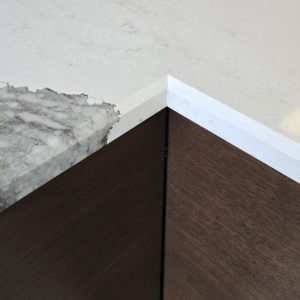
Mitered edges are often used to give the stone a thicker appearance. Certain materials miter much better than others and need to be reviewed with your sales associate and project manager, in advance.
Chiseled Edge Details
A chiseled edge adds natural texture and character to your countertops. Created by carefully removing small pieces of stone along the edge, this finish highlights the raw beauty of the material while maintaining a refined look. Its intentionally rough, uneven surface delivers rustic charm and an organic feel. Because of its textured finish, the edge can be abrasive and may snag clothing or catch on fabrics, making it a better fit for decorative or low-traffic areas.
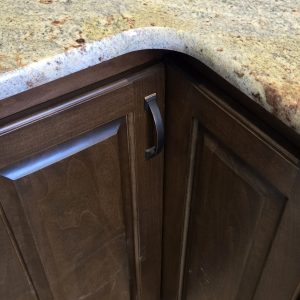
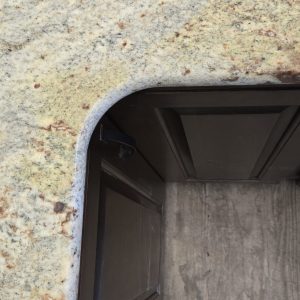
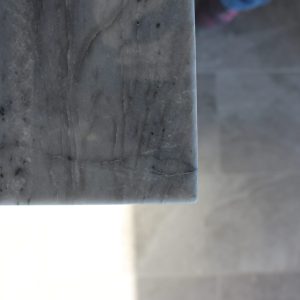
Inside Corner Radius
Outside Corner Radius
- When an inside corner is fabricated without a seam at the center point, the allowable inside radius is determined by the selected edge profile.
- Our standard edge profile minimum inside radius is 1.7 inches.
- All other edge profiles require a 2.5-inch inside radius.
- Standard & T-Edge profiles allow a tighter inside radius without a seam; however, this requires hand fabrication, with possible variation, and carries additional cost. Other Edges do not allow a tighter radius.
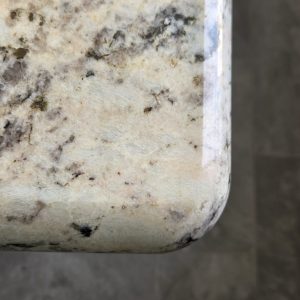
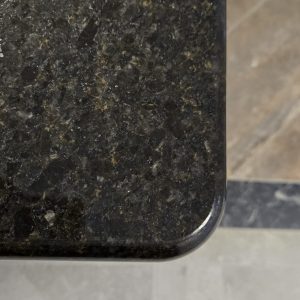
- You may select the amount of rounding for the outside corners of your design.
- BAGM’s standard outside corner radius is 1.5 inches.
- When choosing a radius, consider both the edge profile and the amount of overhang.
- A radius that is too large may expose the top of the cabinetry.
- A radius that is too small may result in a sharper-feeling edge profile.
Cut Outs | Appliances | Other Trades
BAGM products often interact with other trades and purchased components, understanding how these elements work together is essential to a smooth and successful project. Reviewing these details early helps prevent scheduling conflicts, fit issues, or design changes later in the process.
Be sure to review your Template and Install Checklists, along with the BAGM Project Timeline, ensuring you are prepared with all the necessary information before fabrication begins.
BAGM’s focus is on the fabrication and installation of our products. While our staff has general knowledge of other trades, these areas are not our specialty. We intentionally limit our involvement to ensure all work is completed by the appropriate professionals, such as plumbing and electric. BAGM does not preform these trades.
It is important that you have a clear understanding of BAGM’s responsibilities versus those of other contractors. Proper coordination of duties, timelines, and communication between all parties will help ensure your project progresses smoothly and stays on schedule.
Cut-Out Information
All cut-out details must be provided during the job creation phase so they can be reviewed as part of the overall design. In most cases, this means supplying model numbers and manufacturer specifications for your sinks, faucets, cooktops, or other built-in items. These specifications are usually sufficient, however, certain instances require BAGM to review the physical product ahead of time.
Due to manufacturer warranty requirements, perfect square inside corners are not permitted on quartz and porcelain surfaces. These installations require a slightly eased or rounded inside corner to ensure material strength and long-term performance.
Cut-Out Centers
By default, BAGM centers all cut-outs based on the base cabinet doors or drawers beneath them. If you would like your sink, cooktop, or faucet aligned differently—such as centered on lighting, a window, or another visual feature—please communicate this with BAGM during the design phase.
Keep in mind that some sinks have offset bowls, which may cause the faucet to be positioned off-center relative to the overall cut-out.
Cut-Out Depth
Cut-outs are typically placed as close to the front edge of the countertop as practical. This placement helps maximize usability and ensures appliances and fixtures fit properly within cabinetry clearances. If you prefer a greater setback for aesthetic or functional reasons, please discuss this with your BAGM representative ahead of time so the layout can be adjusted accordingly.
Sinks and faucets are primary components in most BAGM projects. Whether you purchase these items through BAGM or supply your own, it is important that your selections are compatible with your overall design, cabinetry, and countertop materials.
Undermount Sinks
Undermount sinks are the most common style used with BAGM products. Mounted below the countertop surface, they offer a clean appearance and make daily cleaning easier.
BAGM utilizes manufacturer CAD cut-out files to ensure precise sizing and alignment for your specific sink model.
Cut-Out Options
- Overhang: BAGM recommends an 1/8″–1/4″ overhang to ensure complete sink coverage and to conceal minor variations between the stone and sink edge.
- Flush: Not recommended as this style exposes even the slightest material or sink variation.
- Reveal: While this style can help hide some inconsistencies, the exposed ledge can collect debris and require more frequent cleaning.
Installation Notes
- Most undermount sinks are adhered along the outer flange and are not finished with caulk at the visible joint. Certain styles—particularly reveal cut-outs—may include finish caulking, which can break down over time and may need occasional touch-up.
- Some sink models include accessories (such as drain racks or cutting boards) that require specific cut-out designs. Please provide these details in advance for review.
Cabinet & Faucet Coordination
Be sure to review your sink selection with your cabinet maker or verify that existing cabinetry can accommodate the sink dimensions. Sinks are being manufactured larger, while cabinet dimensions have remained standard—particularly in recessed door styles, which reduce interior cabinet depth and may make some sinks incompatible.
Faucets and other plumbing fixtures must also be compatible with your sink and cabinetry. Although most faucet designs now feature forward-only handle operation, some still swing backward and may contact walls, backsplashes, or other fixtures. BAGM will position faucet holes as close to the sink cut-out as practical to maximize clearance. In limited spaces, the faucet may need to be secured to the sink flange rather than directly to the countertop.
Self-Rimming (Top-Mounted) Sinks
Self-rimming sinks rest on top of the countertop surface. While less common today due to cleaning challenges, they offer a practical advantage if future replacements are anticipated.
- Most faucet holes on these sinks are integrated through the sink deck.
- BAGM will set the sink in place, but mounting and caulking are completed by the plumber.
- The same cabinet and faucet clearance considerations apply as with undermount sinks.
Vessel Sinks
Vessel sinks sit entirely on top of, or are partially recessed into, the countertop surface. They are popular for vanity applications due to their design flexibility but are more difficult to clean around.
- Each vessel sink must be on site at the time of template for proper review due to variations in shape and mounting style.
- BAGM typically aligns the front edge of the sink with the front face frame of the cabinetry, unless otherwise required by the sink design.
- Mounting and caulking of vessel sinks are performed by the plumber.
Apron & Farmhouse Sinks
Farmhouse sinks required to be set in place, at time of template, but plumbing should not be completed.
Similar to sinks, bathtubs can be installed as either undermount or top-mounted designs. The same considerations apply regarding overhang, flush, or reveal cut-outs. Due to the tub’s edge profile and faucet reach, a reveal-style cut-out is often preferred for bathtubs allowing easier access and provide additional clearance.
Installation Requirements
- Undermount tubs must be set in their permanent location prior to templating to ensure accurate measurement and fit.
- Top-mounted tubs should be mocked in place during templating to confirm location and spacing, then removed prior to countertop installation. The tub can be permanently installed after the hard surface is in place.
Design & Access Considerations
Be sure to review:
- Access panel locations for plumbing and pump service.
- Tub faucet positioning and clearance, as discussed in the Project Types section under Tub Decks.
Finishing
BAGM will caulk around undermount tubs during installation.
For top-mounted tubs, mounting and final caulking are performed by the plumber.
BAGM does not perform any gas or electrical work. All such work must be completed by licensed contractors prior to BAGM’s arrival for installation. Proper coordination with your electrician or plumber is essential to ensure smooth scheduling and a safe work environment.
Cooktops & Ranges
Accurate appliance information is essential for proper fabrication and installation. BAGM will need to confirm the model number and size of your cooktop—most commonly 30″, 36″, 48″, or 60″. Manufacturer specifications are used to determine the precise cut-out or opening size for your countertop.
Be sure to review the Appliance Overhangs section of this guide to understand the best practices for setting cabinet dimensions around ranges and cooktops.
Some cooktops and ranges are designed to pair with a separate downdraft ventilation unit. It is your responsibility to confirm that the selected downdraft model is compatible with your specific appliance.
As with sinks, it is important to coordinate appliance dimensions with your cabinet manufacturer or installer to ensure that the cabinetry can accommodate your chosen equipment.
Flush-mounted cooktops are not recommended by BAGM. Although they may appear seamless, these installations often create small gaps between the countertop and appliance that trap debris and are difficult to clean. In addition, many appliance designs do not allow for the precise tolerances required for a true flush fit. Attempting this type of installation typically involves added fabrication costs and reduced long-term functionality.
While BAGM may occasionally verify appliance fit during the project process, final installation of all appliances is performed by others.
Backsplash Outlets
For projects with full-height backsplash, BAGM will typically need to cut openings for outlets. As mentioned in the Project Types section, relocating outlets to the cabinetry often provides a cleaner aesthetic and improved functionality.
If outlets will remain in the backsplash:
- Electrical boxes should be installed and outlets mounted, but faceplates left off prior to templating.
- After templating, outlets can be unscrewed and tipped into the box to allow for backsplash installation.
- Once installation is complete, outlets can be reset and faceplates reattached.
- Note that longer mounting screws and/or spacers may be required to ensure proper outlet alignment due to backsplash thickness.
Pop-Up Outlets
There are many variations of pop-up outlets, and their installation should be reviewed well in advance of your project’s fabrication and template. While these outlets can offer unique design features, certain models—particularly flush-mounted or hidden designs—are not compatible with hard surface materials due to thickness and structural limitations.
We strongly recommend that pop-up outlets be brought to BAGM prior to templating for review with your project manager, or at a minimum, that manufacturer specifications be provided in advance. If the physical unit is available, please have it on site during templating so our technician can review the exact installation requirements with you.
BAGM does not perform cabinetry or trim work, but we will coordinate closely with your contractors in these areas to ensure proper fit and finish.
In most cases, cabinetry must be fully installed prior to BAGM’s templating and installation—except for any items that will sit on top of the countertops, which are to be installed after the stone surfaces are in place.
For trim or molding that interacts with BAGM products, the opposite approach is recommended. Trim should be set tight to the installed stone to achieve a clean, finished appearance.
During the template activity, BAGM will need to know the size and placement of any trim that will meet or overlap our products. This information ensures proper allowances are made for material fit and final detailing.
BAGM does not perform masonry or tile work, but our team will coordinate with your contractors in these areas to ensure a seamless and professional finish.
For the best results, tile or masonry surfaces should butt into BAGM products rather than overlap them. This approach provides cleaner lines, reduces visible gaps, and ensures a more consistent overall appearance.
Whenever possible, mark the intended locations for tile or masonry before BAGM’s installation. This helps our team plan the best fit and alignment for your stone surfaces in relation to adjacent materials.
Additional Information & Expectations
Seams are a common and expected part of nearly every project BAGM performs—ranging from standard residential kitchens to high-end commercial installations. Due to the nature of the hard surface materials we work with, seams will always be visible to some degree.
Seam Necessity & Placement
The need for seams and their exact placement is determined by several factors, including:
- Material size and availability
- Overall design and layout
- Site access and handling limitations (e.g., can the piece be safely moved into the space)
In many cases, design adjustments—such as modifying cabinet sizes or countertop heights—can help eliminate or relocate seams to less noticeable areas. While some seams are unavoidable, BAGM recommends reviewing your layout with your cabinet designer and sales associate early in the process. Avoiding seams in large islands or peninsula tops, where lighting and viewing angles highlight them most, will often yield the best results.
Seam Quality & Appearance
BAGM takes great pride in producing the highest-quality seams in the industry. We utilize:
- Seam-matching photo technology
- CNC cutting and milling precision
- Pneumatic seam-setting techniques (when possible)
- Color-matched epoxies applied by skilled technicians
Despite these advanced techniques, final seam placement is determined by BAGM based on material characteristics and installation feasibility.
Color variation and grain direction changes across a seam are normal and should be expected. For more information on visual consistency and layout coordination, refer to the Layout Options section of this guide.
Seam Characteristics
- Chipping: Minor chipping can occur during fabrication and may make a seam slightly more noticeable. BAGM takes every precaution to minimize this.
- Lippage: Raw materials can have natural concave or convex curvature. In accordance with Natural Stone Institute (NSI) standards, up to 1/32″ height difference at a seam is considered acceptable.
Gaps are common in countertop installations, often intentional to allow proper fitting.
- Wall Gaps: Tops are set within ⅜’’ of a back wall (without backsplash) and ⅛’’ of a side wall. With stone backsplash, tolerances adjust to match wall conditions.
- Crowned or Bowed Walls: Hard surfaces cannot flex to uneven walls. BAGM fills gaps with paintable caulk. Larger gaps may need to be recaulked over time by the customer.
- Cabinet Gaps: Cabinets are not always perfectly level. BAGM may shim counters as needed, or recommend a carpenter if variation is excessive. Clear silicone is used to fill gaps; trim can be added later for aesthetics. Industry standard requires cabinets level to within ±⅛’’ over 10 feet.
- Tile Backsplash Gaps: Existing tile may not align perfectly with stone. Gaps may appear and can be filled with grout-matched caulk if provided by the customer; otherwise, filling is the responsibility of the customer or contractor.
BAGM takes great care to protect your home or job site during installation; however, minor incidental damage is an inherent part of the construction process. Understanding what to expect will help you prepare your space and minimize potential issues.
Walls, Cabinets, Appliances & Floors
Minor dings, scratches, or scuffs may occur during installation. BAGM uses protective materials such as rugs, laminate sheets, and moving pads, but 100% protection cannot be guaranteed.
- BAGM may loosen or remove cabinet panels or other trim pieces when necessary to ensure a proper fit.
- Appliances should be removed prior to installation when possible, though this is not always required.
- BAGM will always error on the side of protecting cabinetry over drywall, as walls can be more easily repaired.
Fixtures
If you plan to reuse sinks, faucets, or other fixtures, they must be fully removed prior to installation. BAGM cannot be responsible for damage to fixtures that remain in place.
Tile Backsplash
Existing tile backsplashes may be damaged during removal of old countertops. Replacement or repair of these materials is the responsibility of the homeowner or contractor.
Mirrors
In bathroom installations, mirrors should be removed before countertop installation to prevent breakage or scratching.
Remodel Lines
When replacing old countertops, you may notice remodel lines—visible areas where the new countertop’s thickness differs from the previous one. These variations are normal and may require touch-up work by others.
Removal & Disposal
When BAGM performs removal and disposal of existing countertops, there is an increased risk of incidental damage to walls, cabinetry, or surrounding finishes. BAGM is not responsible for damage that may occur during this process.
Dust & Cleanup
Certain on-site cutting and adjustments—especially for top-mount sinks and cooktops—can produce dust or debris. While BAGM uses vacuums and dust-control methods, some cleanup will still be necessary after installation.
To help minimize dust and protect your home:
- Turn off HVAC systems during installation.
- Seal off adjacent rooms and cover appliances or finishes.
- Use caution when cleaning hard-surface dust to avoid scratching your new countertops.
BAGM completes cleanup to a “broom-swept” level, leaving the work area generally clean but not detailed. Full and final cleaning is the responsibility of the customer.
BAGM uses standard caulking products suited to the materials and conditions of your installation. If you would like to use a specific color-matched silicone or grout caulk, please communicate this to BAGM in advance and provide the product before your scheduled installation.
Stone to Stone & Stone to Cabinet
BAGM uses Akemi Clear 100% Silicone, a durable bonding silicone designed for hard surfaces. This thicker silicone holds up well over time and has a slight haze, giving it a semi-transparent finish rather than completely clear.
Stone to Drywalled Walls
For areas where the countertop meets drywall, BAGM uses either clear or white paintable caulk.
- Clear paintable caulk applies white and dries clear, but tends to shrink more than white paintable caulk.
- For larger gaps, BAGM typically uses white paintable caulk, which can be easily painted by you or your painter to match wall color after installation.
Other Finishes
BAGM may decline to caulk against certain materials or surfaces, such as textured wallpaper, tile, specific window materials, or masonry. These areas are best addressed by other trades. Please discuss these details with your sales associate or project manager to clarify responsibilities prior to installation.
Exterior Conditions
Please ensure all access pathways are clear of debris, snow, and ice prior to crew arrival to support safety and efficient installation. During the installation process, temporary tire or trailer tracks may occur on driveways or lawns as a result of delivery and service vehicles.
Site Ready
Sites that are not ready at the time of the scheduled visit may incur additional charges and cause project delays. To ensure site is ready, be sure to review Template Checklist & Install Checklist in advance of scheduling.